An Impossible Sound
Rory Pilgrim
Solo exhibition
5 April – 14 June 2026
Vleeshal
Curator: Martha Jager
An Impossible Sound was conceived as the third instalment of pink & green, Rory Pilgrim’s long-term project that will culminate in his forthcoming first feature film of the same title. Presented at Vleeshal, the exhibition unfolded as an immersive environment foregrounding the choices faced by young people growing up in regional areas.
The project was grounded in the voices and landscapes of the Isle of Portland, a small limestone island linked to the Dorset coast by Chesil Beach. Portland’s geology has long played a defining role in its identity: for centuries, the island’s limestone has been quarried and used to construct some of Britain’s most recognisable landmarks, including the Tower of London. At the same time, the landscape bears the marks of environmental extraction alongside the presence of carceral infrastructures. Portland is home to two prisons, including HMP/YOI Portland, and was formerly the site of the prison barge HMP Weare. The labour of imprisoned people has historically shaped the island’s terrain, with many of its quarries first worked by prisoners brought there in 1848 to construct the 2.84-mile harbour breakwater.
Working closely with island residents over several years—including young people living on the island and men imprisoned at HMP/YOI Portland—Pilgrim explored how individual lives are shaped by legal systems, environmental conditions and inherited social structures. Central to the project was a collaborative methodology developed with Elizabeth Graham, in which participants were not simply subjects of representation but active contributors to the work’s development. Through workshops, writing sessions, collective song-making and ongoing dialogue, the project unfolded gradually, allowing relationships and trust to develop over time.
Within contexts marked by institutional constraint and unequal power relations, Pilgrim’s process involved creating structures of care that enabled collaboration to take place. Working alongside young people, educators, support staff and community organisations, these frameworks emphasised listening, consent and shared authorship. Spaces for reflection and collective discussion formed an integral part of the artistic process, allowing participants to shape the stories, lyrics and sonic textures that became the foundation of the work. In this way, the creative process became inseparable from the social conditions that sustained it, foregrounding care and collaboration as both method and subject.
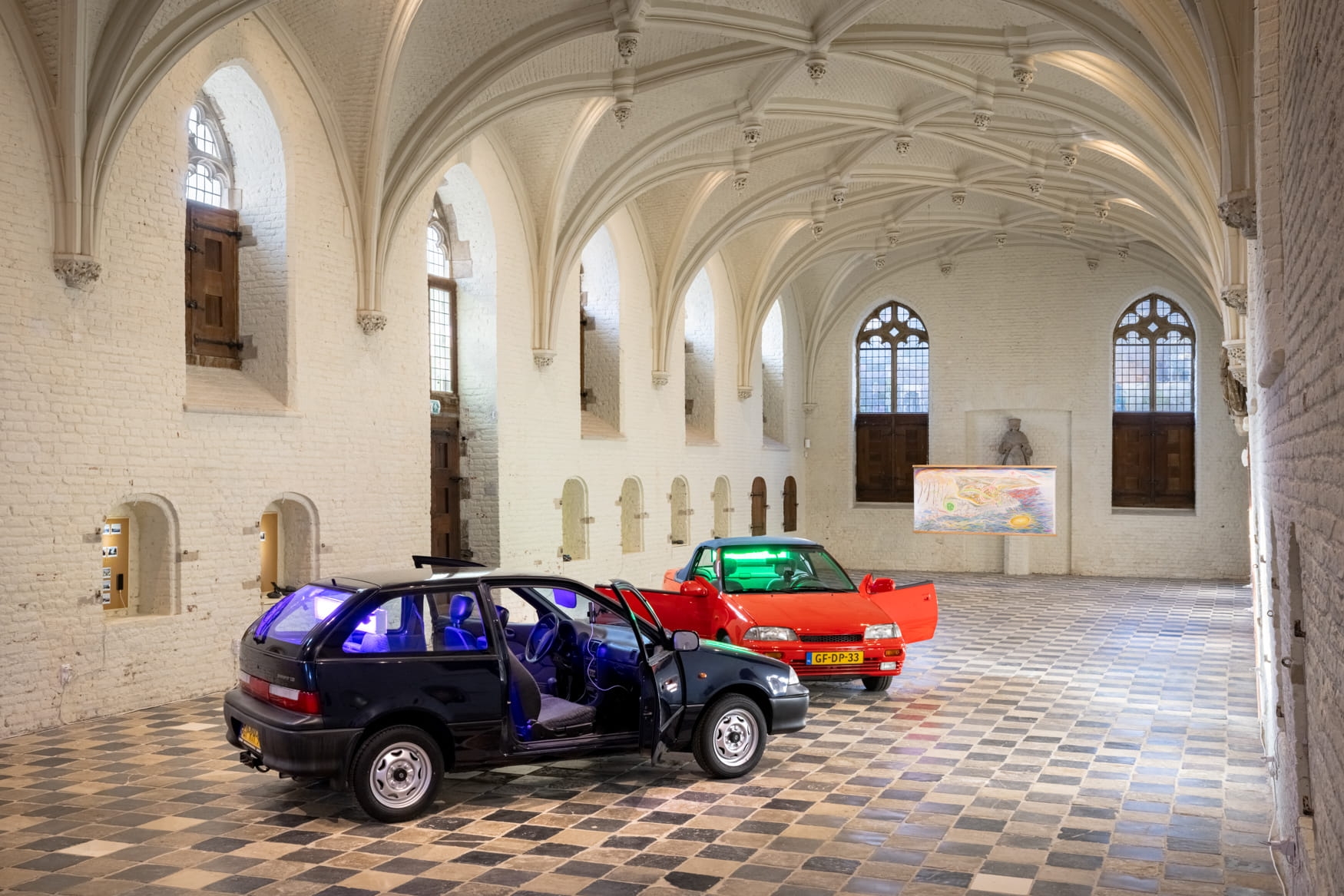
At the heart of An Impossible Sound was the musical score for the forthcoming film. Exploring the idea of the musical loop, the exhibition’s title referred to a moment in which a cycle of harm might be interrupted, opening up the possibility of renewal and transformation. Particular attention was given to the experiences of teenagers growing up on the island and asking themselves what it means to stay or leave. At the centre of the exhibition, two cars stood nose to nose with their doors open wide. Each vehicle carried an unfolding audio journey narrated by a series of passengers, including teenagers and film protagonists Chloe Peplow and Ellia Webb. These personal songs—alongside the voice of the island itself, embodied by singer Robyn Haddon—functioned both as a road-trip playlist and as contemporary vespers: a shared, reflective ritual. Together with drawings, video fragments and Polaroid photographs, the exhibition invited visitors to experience the island as a microcosm of the wider world and to listen closely for the fragile moments where change might begin.
Persons
This project was made possible by the generous support of the Dutch Ministry of Education, Culture and Science and the municipality of Middelburg.